Tolerance reasoning
Explain Drawings, Dimensions and Tolerances | V4
General language | تعليم لغات عام • 2027
Final reviewed V4 path with strengthened Computing questions, full pre-question visual coverage, and verified audiovisual support across Computing stages.
شاهد تجربة حقيقية من داخل المسار قبل أن تبدأ
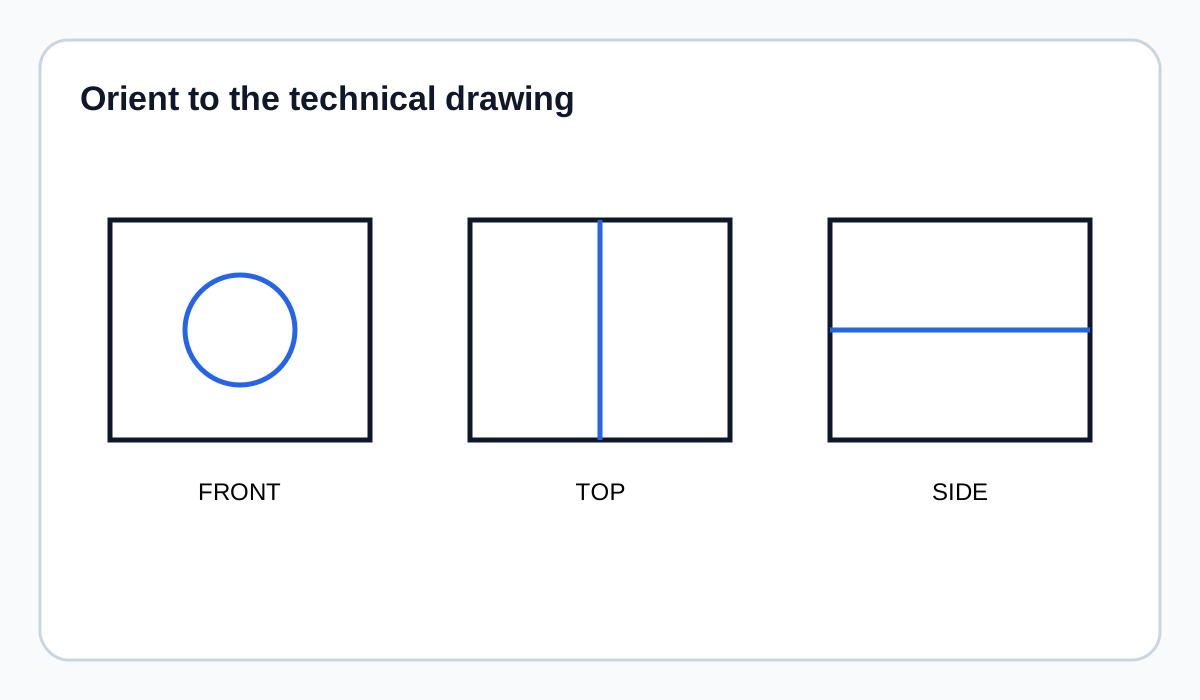
داخل المسار
Orient a listener to a technical drawing or view
مش مجرد وصف — دي معاينة من المحتوى الفعلي.
داخل المسار
صور وفيديوهات وأمثلة مأخوذة من المحتوى المنشور نفسه، حتى تعرف أسلوب التعلم قبل التسجيل.
en-US
B1-B2 • General American • support: ar
en-US
B1-B2 • General American • support: ar
en-US
B1-B2 • General American • support: ar
en-US
B1-B2 • General American • support: ar
en-US
B1-B2 • General American • support: ar
en-US
B1-B2 • General American • support: ar
Tolerance reasoning
Explain Drawings, Dimensions and Tolerances | V4
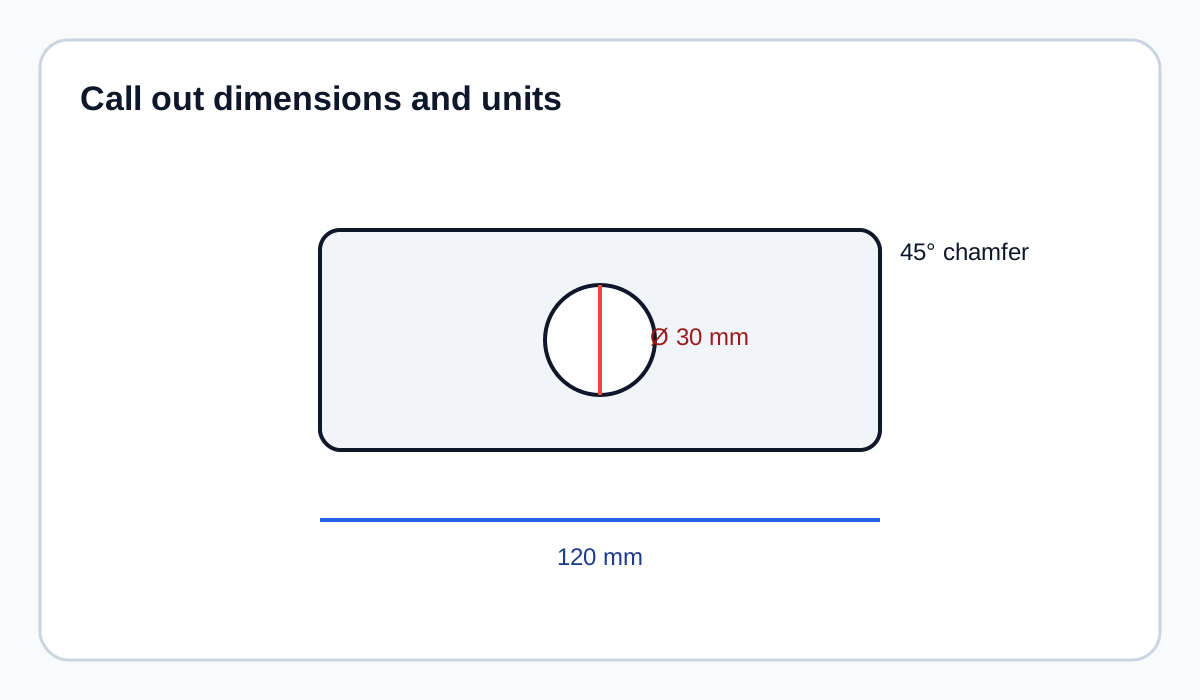
Call out dimensions and units unambiguously
Explain Drawings, Dimensions and Tolerances | V4
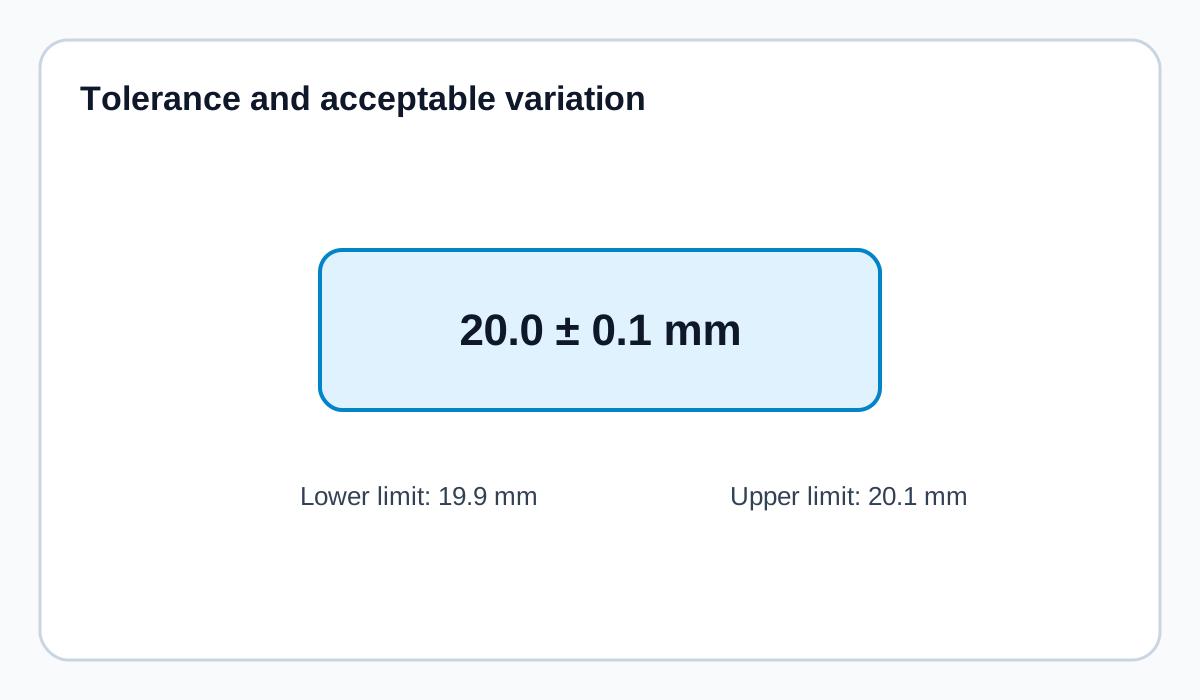
Explain tolerances, fits and acceptable variation
Explain Drawings, Dimensions and Tolerances | V4
Before discussing dimensions, identify the drawing type and view, then establish a reference such as front/top/side, section, datum or scale.
Locate the same feature across views before describing it.
Avoid bare numbers such as “this is 25.” State the feature, value, unit and reference when needed.
The center-to-center distance between the two mounting holes is 25 millimeters in the front view.
For 20.0 mm ± 0.1 mm, nominal is 20.0 mm, lower limit 19.9 mm and upper limit 20.1 mm. In a review, connect the tolerance to function.
Translate the notation into lower limit, upper limit and function.
خطة التعلم
Master Foundation & Academic Technical Communication through realistic professional tasks.
Identify a speaker's name, field, role and project from a short introduction
Extract key identity and project information from spoken or written introductions.
Give a concise technical self-introduction
Produce a clear 30-second introduction naming your field, current role or study focus, and one relevant technical interest.
Name tools, technologies and engineering domains precisely
Use accurate technical nouns for software tools, programming languages, platforms, engineering domains and project types.
Answer a follow-up question about your project or specialization
Respond to a natural follow-up question with a specific example rather than a memorized generic answer.
Ask for repetition or slower speech politely
Use natural professional phrases to request repetition, slower speech or a restatement without interrupting the technical discussion.
Clarify an unfamiliar technical term or acronym
Ask what a term, abbreviation or acronym means and request a short example when needed.
Master Listening & Reading Technical Information through realistic professional tasks.
Identify the topic, purpose and audience of a technical explanation
Listen for the speaker's main subject, intended outcome and assumed listener knowledge.
Track signposting language through a technical explanation
Recognize phrases that introduce sequence, cause, contrast, examples, conditions and conclusions.
Distinguish definitions, examples, evidence and conclusions
Classify the function of information while listening instead of treating all details equally.
Reconstruct the outline of a technical explanation
Produce a short ordered outline showing the explanation's major stages and relationships.
Recognize sequence markers in spoken procedures
Identify first, next, then, once, before, after, finally and equivalent sequencing language.
Extract conditions, exceptions and prerequisites
Identify what must be true before a step, when an exception applies and what depends on a condition.
Master Precision, Systems & Procedures through realistic professional tasks.
Pronounce decimals, large numbers and version numbers clearly
Say values such as 0.025, 12,500, 3.3 and version 2.14 without ambiguity.
Say units, symbols and engineering quantities naturally
Use correct spoken forms for units such as millimeters, volts, megabytes, kilohertz and degrees Celsius.
Express ranges, limits and tolerances accurately
Communicate minimums, maximums, plus-or-minus values, acceptable ranges and upper or lower bounds.
Confirm a numerical value using read-back
Repeat a critical number with its unit and context to verify that both speakers understood the same value.
Ask a targeted confirmation question about a technical value
Check one specific number, unit, condition or parameter instead of asking a vague 'Is this correct?' question.
State an assumption explicitly before using it
Use phrases such as assuming that, based on, or unless otherwise specified to make hidden assumptions visible.
Master Troubleshooting, Data & Evidence through realistic professional tasks.
Separate observed behavior from expected behavior
Describe what actually happened and what should have happened without mixing interpretation into the observation.
Report an error message or failure signal accurately
Quote or paraphrase the essential error, code, indicator or alarm while preserving technically relevant details.
Distinguish intermittent, reproducible and environment-specific failures
Use frequency and condition language to explain when and where a problem appears.
State technical impact and severity
Explain which users, components, functions, deadlines or safety conditions are affected by the failure.
Form a testable troubleshooting hypothesis
Propose a possible cause in a way that can be confirmed or rejected by a specific check.
Propose the next diagnostic check and expected evidence
State what to inspect or test and what result would support or weaken the hypothesis.
Master Team, Email & Technical Documentation through realistic professional tasks.
Give a concise stand-up style technical update
Report completed work, current task, blocker and next action in a short professional update.
Ask for help with enough technical context
Describe the goal, what was tried, current evidence and the exact help needed.
Offer technical support without taking over ownership
Suggest a useful action, resource or pairing step while keeping responsibilities clear.
Agree and restate the next team action
Confirm who will do what, by when and what result or handoff is expected.
Signal technical disagreement respectfully
Use neutral language that challenges an idea, assumption or design choice rather than the person.
Support disagreement with evidence or constraints
Reference requirements, measurements, risks or observed behavior instead of relying on preference.
Master Presentations, Mediation & Technical Decisions through realistic professional tasks.
Open a technical presentation with purpose and outcome
Tell the audience what problem, system or decision the presentation addresses and what they should understand by the end.
Use signposting to structure presentation sections
Guide the audience through context, method, result, decision and next-step sections.
Explain a visual without reading it aloud
Direct attention to the relevant part of a diagram, chart or architecture view and interpret what it means.
Close with key takeaways and a controlled Q&A transition
Restate the main result or recommendation before inviting focused questions.
Adjust terminology for technical and non-technical listeners
Choose when to keep specialist terms, define them or replace them with plain language.
Use an analogy without distorting the technical idea
Map a complex concept to a familiar comparison and state where the analogy stops being accurate.
Master Career, Interview & Portfolio Communication through realistic professional tasks.
Write achievement-focused technical experience statements
Describe action, technology, problem and measurable result instead of listing generic responsibilities.
Explain technical responsibilities in interview language
Describe scope, ownership, collaboration and tools in a way a recruiter or engineering manager can follow.
Tell a structured STAR story about a technical challenge
Present situation, task, action and result while emphasizing your specific contribution.
Quantify technical impact honestly
Use time, performance, reliability, cost, quality or scale metrics without exaggeration.
Clarify an ambiguous technical interview question
Ask a short question to confirm assumptions, constraints or expected scope before answering.
Think aloud through a technical problem in a structured way
State assumptions, options, reasoning and checks so the interviewer can follow the process.
Master Computing Systems & Developer Communication through realistic professional tasks.
Define system boundaries and key users
Explain what is inside and outside a software system and identify the main user or external-system actors.
Describe frontend, backend, data and service responsibilities
Explain which layer or service owns presentation, business logic, storage and integration tasks.
Trace a request or data flow across the architecture
Describe how a user action or message moves through interfaces, services, databases or queues.
Explain external dependencies and integration constraints
State which third-party services, protocols, versions or infrastructure assumptions affect the system.
Elicit a requirement from a stakeholder need
Turn a vague need into a specific question and capture the intended user outcome.
Distinguish functional and non-functional requirements
Classify what the system must do versus qualities such as performance, security, reliability or usability.
Master Computing Debugging, Design & Product Demo through realistic professional tasks.
Write a concise reproducible bug title
Name the affected behavior and failure condition without vague wording such as 'not working'.
Document environment and preconditions
Record version, platform, configuration, permissions, data state or hardware needed to reproduce the issue.
Write reproduction steps with actual and expected results
Provide an ordered path to the failure and separate observed behavior from intended behavior.
Attach evidence and communicate severity
Reference logs, screenshots, traces or measurements and explain the bug's impact and priority.
Describe a test scenario and expected behavior
State test purpose, setup, action and expected outcome in language another developer can repeat.
Interpret a failure, log or assertion message
Extract the relevant signal from test output and explain what it suggests without assuming the final cause.
Master Engineering Components, Materials & Specifications through realistic professional tasks.
Identify an engineering component or material precisely
Use correct names for components, materials, assemblies and physical features.
Describe properties relevant to engineering use
Explain strength, stiffness, conductivity, thermal behavior, mass, corrosion resistance or other task-relevant properties.
Connect component function to material or geometry
Explain why a part's material, shape or construction supports its intended function.
Compare engineering alternatives using properties and use conditions
Evaluate two components or materials against operating environment and design criteria.
Read and restate a key technical specification
Identify the parameter, required value, unit and condition from a datasheet or requirement.
Distinguish mandatory requirements from preferences
Use language that separates shall or must constraints from should or preferred targets.
Master Engineering Drawings, Dimensions & Tolerances through realistic professional tasks.
Orient a listener to a technical drawing or view
Identify the drawing type, view, scale or reference frame before discussing details.
Call out dimensions and units unambiguously
Describe lengths, diameters, angles, coordinates and units while referencing the correct feature.
Explain tolerances, fits and acceptable variation
State nominal values, upper and lower limits and the functional reason for tolerance where relevant.
Describe relationships between features on a drawing
Explain alignment, spacing, attachment, orientation or interface relationships using precise spatial language.
Master Engineering Measurement & Experimental Communication through realistic professional tasks.
Describe an experimental or measurement setup
Name the equipment, sensor or instrument arrangement and what each element measures or controls.
Explain variables, controls and measurement procedure
Distinguish what changes, what is held constant and how data is collected.
Report observations separately from interpretation
State measured or visible results before offering an explanation or conclusion.
Describe uncertainty, anomaly or possible measurement error
Identify unusual data and explain plausible instrument, setup or procedural causes without hiding the issue.
Master Engineering Requirements, Risk, Reports & Design Review through realistic professional tasks.
Turn a stakeholder need into a measurable engineering requirement
Translate a broad need into a statement with observable performance, condition and acceptance information.
Define success criteria and verification method
State how a requirement will be measured, inspected, tested or otherwise verified.
Prioritize requirements using explicit categories
Classify requirements as critical, high priority, optional or deferred based on stakeholder and system impact.
Resolve conflicting requirements through clarification and trade-off
Identify the conflict, ask the right stakeholder questions and document the agreed priority or compromise.
Identify a technical hazard or project risk
Describe the initiating condition, possible consequence and affected people, assets, schedule or performance.
Compare cost, performance, schedule and safety trade-offs
Explain how changing one design objective affects the others under real constraints.
Integrate computing and engineering communication in a cross-disciplinary design and handoff simulation.
Define a cross-disciplinary system problem and boundary
Describe the shared problem, users, physical and digital boundaries and success criteria for a mixed computing-engineering team.
Explain hardware-software interface responsibilities
State what data, signals, power or commands cross the interface and which side owns validation and failure handling.
Integrate measurements and software behavior in one explanation
Connect sensor or experimental data to software processing, control logic or user-visible output.
Present a joint design decision across disciplines
Explain how computing and engineering constraints were balanced and what evidence supports the integrated choice.
Explain a complete technical solution to a mixed audience
Present problem, architecture or design, operation and value at a depth suitable for both technical and non-technical listeners.
Defend key design decisions and constraints
Respond to questions about alternatives, requirements, risk, performance, cost, maintainability or safety with evidence.
Prove independent mastery across all 204 canonical outcomes before certificate completion.
Identify a speaker's name, field, role and project from a short introduction
Extract key identity and project information from spoken or written introductions.
Give a concise technical self-introduction
Produce a clear 30-second introduction naming your field, current role or study focus, and one relevant technical interest.
Name tools, technologies and engineering domains precisely
Use accurate technical nouns for software tools, programming languages, platforms, engineering domains and project types.
Answer a follow-up question about your project or specialization
Respond to a natural follow-up question with a specific example rather than a memorized generic answer.
Ask for repetition or slower speech politely
Use natural professional phrases to request repetition, slower speech or a restatement without interrupting the technical discussion.
Clarify an unfamiliar technical term or acronym
Ask what a term, abbreviation or acronym means and request a short example when needed.
English for Computing and Engineering
Final reviewed V4 path with strengthened Computing questions, full pre-question visual coverage, and verified audiovisual support across Computing stages.