British Council — Giving Clear Instructions
Run a Simple Science Activity in English | وجّه نشاط Science بالإنجليزية
General language | تعليم لغات عام • 2027
A complete Arabic-supported English-for-Science-Teacher path with validated route coverage, General American language practice, high-quality evidence-based questions, multimedia learning, and an integrated capstone.
شاهد تجربة حقيقية من داخل المسار قبل أن تبدأ
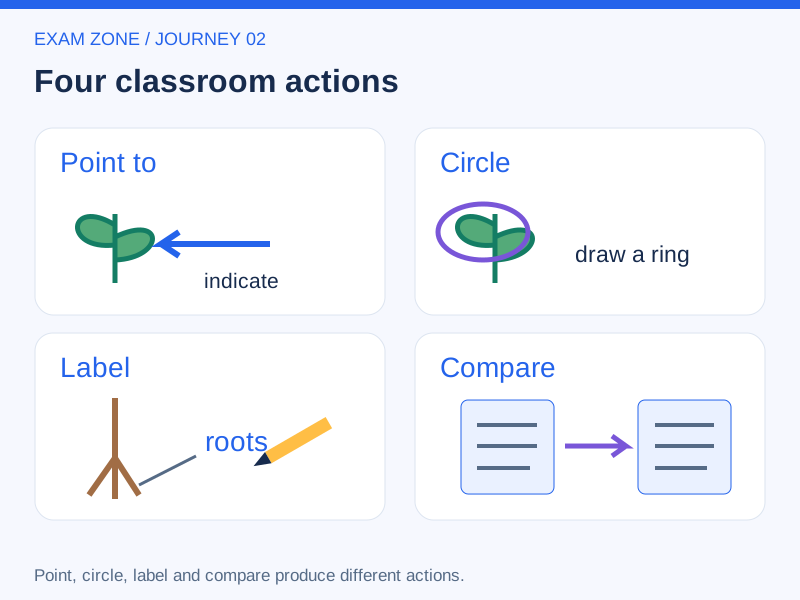
داخل المسار
C01 | شاهد معنى Label
مش مجرد وصف — دي معاينة من المحتوى الفعلي.
داخل المسار
صور وفيديوهات وأمثلة مأخوذة من المحتوى المنشور نفسه، حتى تعرف أسلوب التعلم قبل التسجيل.
en-US
General American • support: ar
en-US
General American • support: ar
en-US
General American • support: ar
en-US
General American • support: ar
en-US
General American • support: ar
en-US
General American • support: ar
British Council — Giving Clear Instructions
Run a Simple Science Activity in English | وجّه نشاط Science بالإنجليزية
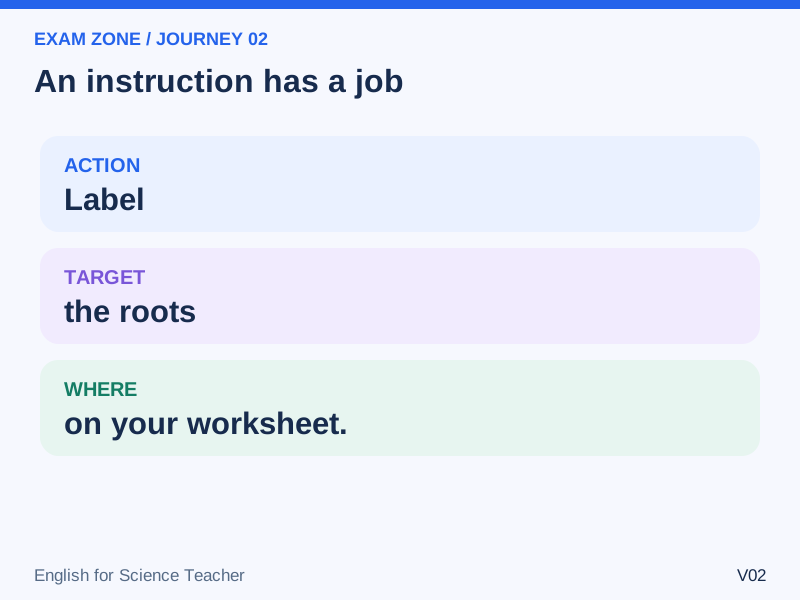
C02 | فكّك التعليمة
Run a Simple Science Activity in English | وجّه نشاط Science بالإنجليزية
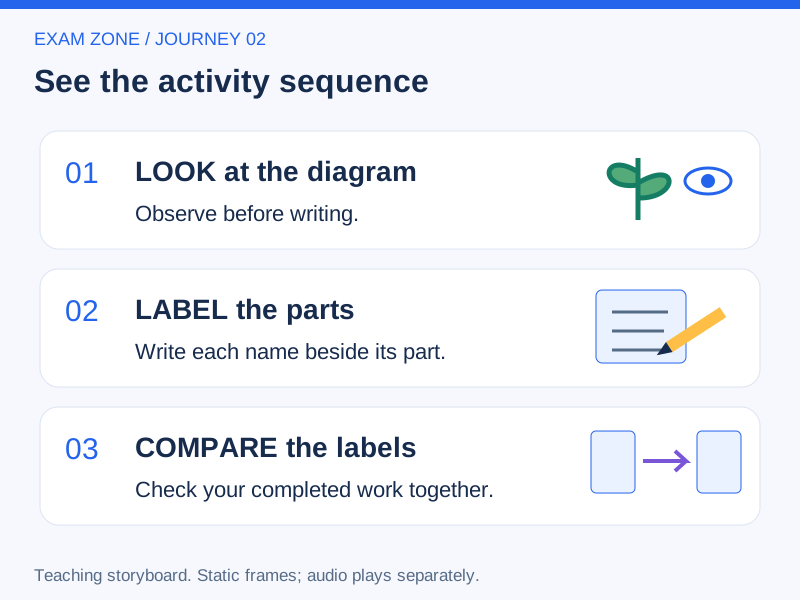
C08 | شاهد ثلاث خطوات
Run a Simple Science Activity in English | وجّه نشاط Science بالإنجليزية

C15 | العمل الفردي والأزواج والمجموعات
Run a Simple Science Activity in English | وجّه نشاط Science بالإنجليزية
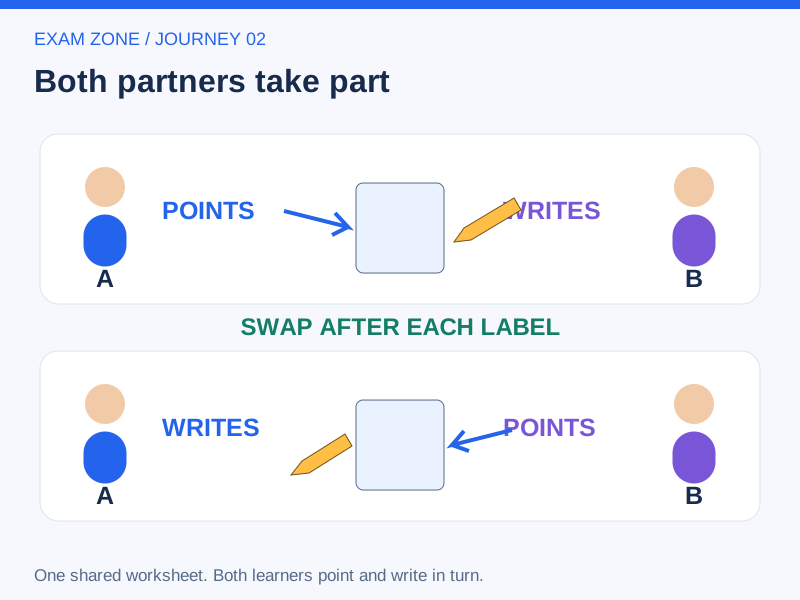
C16 | كل شريك له دور
Run a Simple Science Activity in English | وجّه نشاط Science بالإنجليزية
C01 | شاهد معنى Label
C08 | شاهد ثلاث خطوات
اللغة المستهدفة
Label the roots on your worksheet.
الدعم
Label يعني اكتب اسم الجزء؛ point to يعني أشر إليه؛ circle يعني ارسم دائرة حوله. لاحظ الفعل في الرسم ثم اسمع التعليمة.
Label means write a name beside the part. Point to means indicate it; circle means draw a ring. The model specifies the action, the roots and the worksheet.
اللغة المستهدفة
Label | the roots | on your worksheet.
الدعم
اعمل إيه؟ على إيه؟ وفين؟ استخدم الفعل الأساسي بعد Please، من غير to.
Label is the base verb, the roots identifies the target, and on your worksheet specifies where to work. Please label the roots is correct; Please to label the roots is not. Include a location when the task needs it.
اللغة المستهدفة
First, look at the diagram. Next, label the roots, stem, and leaves. Finally, compare your labels with your partner.
الدعم
تابع المشاهد الثابتة واسمع كيف يرتب المدرس الخطوات في جمل قصيرة.
Look first, label next and compare last. First and Next or Then show order; Finally introduces the last step. Keep each instruction short.
اللغة المستهدفة
First, look at the diagram. Next, label the parts. Finally, compare your labels.
الدعم
افصل الأفعال وحدد ترتيبها. Then بديل مناسب لـNext هنا.
Vague: Do the diagram and the labels and talk. Clearer: First, look at the diagram. Next, label the parts. Finally, compare your labels.
اللغة المستهدفة
Work in pairs. Share one worksheet with your partner.
الدعم
شوف الفرق بين ترتيبات الطلاب. كل زوج في النموذج يشترك في ورقة واحدة.
Individual work means alone. A pair has two learners; a group of three has three. The model uses pairs sharing one worksheet. State both who works together and how the sheets are shared.
اللغة المستهدفة
Student A, point to a part. Student B, write its name. Swap roles after each label.
الدعم
واحد يشير والتاني يكتب، وبعد كل تسمية يتبادلوا الأدوار.
For the current label, A points and B writes. After that label they swap: B points and A writes. They still share one worksheet.
خطة التعلم
Master Opening a Science Lesson in practical classroom English and demonstrate it in authentic science-teaching situations.
Open the lesson confidently
Use a concise professional opening in English to settle the class and establish the science focus.
State a student-friendly objective
Say what students will learn using clear measurable classroom English.
Activate prior knowledge
Use short prompts to connect the new science idea to what students already know.
Gain and regain attention
Use natural attention signals and concise teacher language.
Preview the lesson roadmap
Tell students what will happen first, next and finally.
Announce the lesson topic in one clear English sentence
Given a primary Science topic, produce one correct student-facing sentence using Today, we are learning about... or an equivalent appropriate construction.
Master Instructions, Grouping and Transitions in practical classroom English and demonstrate it in authentic science-teaching situations.
Give one-step science instructions
Use clear imperatives for simple classroom and practical tasks.
Sequence multi-step instructions
Use first, next, then, after that and finally accurately.
Set pairs and groups
Assign partners, roles and groups using concise classroom English.
Set time and completion limits
Tell students how long they have and what finished work should look like.
Signal transitions smoothly
Move students between explanation, activity, discussion and review.
Master Checking Understanding and Managing Interaction in practical classroom English and demonstrate it in authentic science-teaching situations.
Use instruction-checking questions
Check whether students know what to do without asking only Do you understand?.
Use concept-checking questions
Check the meaning of a science idea with short targeted questions.
Use effective wait time
Pause after questions and invite thinking before taking answers.
Praise specifically
Use feedback that names what the student did well.
Correct errors without stopping participation
Respond to language or science errors while keeping the learner engaged.
Master Living Things and Life Processes in practical classroom English and demonstrate it in authentic science-teaching situations.
Distinguish living and non-living things
Describe observable characteristics that separate living from non-living things.
Use life-process verbs
Use grow, move, breathe, feed, reproduce and respond in accurate science sentences.
Describe basic needs of organisms
Explain needs such as water, air, food, light and suitable conditions.
Build simple classification sentences
Use is, is not, has and can to classify examples.
Ask observation questions about living things
Use What do you notice?, What can it do? and How do you know? appropriately.
Master Plants and the Human Body in practical classroom English and demonstrate it in authentic science-teaching situations.
Name and describe plant parts
Use root, stem, leaf, flower, seed and fruit with their basic functions.
Explain structure and function
Use language such as The roots absorb water and The heart pumps blood.
Name major body organs
Use key organ vocabulary accurately in spoken explanations.
Describe body systems simply
Explain what a system does using age-appropriate English.
Compare plant and human functions
Use both, while, unlike and whereas to compare functions.
Master Habitats, Food Chains and Adaptation in practical classroom English and demonstrate it in authentic science-teaching situations.
Describe a habitat
Use habitat vocabulary and location phrases to describe where organisms live.
Explain a simple food chain
Use producer, consumer, predator, prey and energy flow in sequence.
Use adaptation language
Explain how a feature helps an organism survive.
Classify organisms using evidence
Give a category and one observable reason.
Ask higher-order life-science questions
Use why, how and what would happen if questions around ecosystems.
Master States and Properties of Matter in practical classroom English and demonstrate it in authentic science-teaching situations.
Name the states of matter
Use solid, liquid and gas accurately in classroom explanations.
Describe material properties
Use hard, soft, flexible, rigid, transparent, absorbent, magnetic and conductive.
Compare properties
Use comparative forms to compare materials for a purpose.
Use particle language at an age-appropriate level
Describe particles as close together, spread out or moving.
Ask property-testing questions
Frame questions that can be answered by observing or testing materials.
Master Changes of State and Mixing in practical classroom English and demonstrate it in authentic science-teaching situations.
Use process verbs accurately
Use melt, freeze, evaporate, condense, dissolve and mix in context.
Describe a process in sequence
Explain a change using ordered steps.
Use passive voice for processes
Say forms such as Water is heated and The vapor is cooled.
Distinguish reversible and irreversible changes
Explain whether a change can be reversed and why.
Explain dissolving without confusing it with melting
Use correct classroom language to separate the two ideas.
Master Heat, Temperature and Cause-Effect in practical classroom English and demonstrate it in authentic science-teaching situations.
Distinguish heat and temperature in teacher language
Use the two terms accurately when explaining observations.
Use increase and decrease language
Describe changes in measured quantities.
Build cause-effect science sentences
Use because, so, therefore and as a result.
Explain particle motion with heating and cooling
Describe faster and slower particle motion clearly.
Correct a common matter misconception
Rephrase an inaccurate student statement into a scientifically clearer explanation.
Master Forces and Motion in practical classroom English and demonstrate it in authentic science-teaching situations.
Use force and motion vocabulary
Use push, pull, gravity, friction, speed, direction and motion accurately.
Describe changes in motion
Explain speeding up, slowing down, stopping and changing direction.
Compare effects of friction
Use more, less, greater and smaller with evidence.
Ask fair-test questions about forces
Frame a testable question with one changed factor.
Explain force evidence from observations
Use observation language to connect evidence to a conclusion.
Master Energy, Light and Sound in practical classroom English and demonstrate it in authentic science-teaching situations.
Talk about energy transfer
Use transfer, source and output in simple explanations.
Explain light behavior
Use reflect, absorb, transparent, translucent and opaque.
Explain basic sound production
Use vibrate, vibration, pitch and loudness.
Compare light or sound observations
Use comparative language linked to evidence.
Use prediction language in physical science
Make and justify a prediction before a simple investigation.
Master Electricity and Magnetism in practical classroom English and demonstrate it in authentic science-teaching situations.
Name circuit components
Use cell, battery, wire, bulb, switch and circuit accurately.
Explain open and closed circuits
Describe why a bulb lights or does not light.
Use conductor and insulator
Classify materials and give a reason.
Describe magnetic attraction and repulsion
Use pole, attract, repel and magnetic field at an appropriate level.
Give electrical safety instructions
Use clear imperatives and modals for safe classroom practice.
Master Weather and the Water Cycle in practical classroom English and demonstrate it in authentic science-teaching situations.
Use weather measurement vocabulary
Use temperature, rainfall, wind speed, cloud cover and forecast.
Explain evaporation and condensation
Describe the two processes clearly and contrast them.
Sequence the water cycle
Use evaporation, condensation, precipitation and collection in order.
Read and describe simple weather data
State a trend or comparison from a simple table or graph.
Ask evidence-based weather questions
Ask students to support a weather claim with data.
Master Earth Materials, Resources and Environment in practical classroom English and demonstrate it in authentic science-teaching situations.
Use rock, soil and resource vocabulary
Describe basic Earth materials and natural resources.
Explain renewable and non-renewable
Use clear contrast language with examples.
Describe environmental cause and effect
Connect actions to pollution, habitat change or resource use.
Use reduce, reuse and recycle in context
Explain practical actions and their purpose.
Facilitate an evidence-based environmental discussion
Invite claims, reasons and evidence without turning discussion into memorization.
Master Earth and Space in practical classroom English and demonstrate it in authentic science-teaching situations.
Use Solar System vocabulary
Use planet, star, moon, orbit, axis and solar system.
Distinguish rotation and revolution
Explain each movement with clear teacher language.
Explain day and night simply
Connect Earth rotation to observable day-night changes.
Describe relative position and scale
Use nearer, farther, larger, smaller and between.
Ask model-based space questions
Use a diagram or model to prompt explanation rather than recall only.
Master Lab Equipment and Measurement in practical classroom English and demonstrate it in authentic science-teaching situations.
Name common lab equipment
Use beaker, test tube, measuring cylinder, thermometer, balance and ruler.
Use measurement units accurately
Say and write common metric units in science tasks.
Read measurement instructions
Interpret measure, record, estimate and compare.
Ask for precise observations
Prompt students to report what they see rather than guess causes.
Describe measurement uncertainty simply
Use about, approximately and nearest in appropriate contexts.
Master Procedures and Practical Instructions in practical classroom English and demonstrate it in authentic science-teaching situations.
Give safe procedural imperatives
Use add, pour, stir, place, heat, observe and record.
Chunk a procedure into manageable steps
Give no more information than students can act on at once.
Check practical-task understanding
Use short instruction-checking questions before equipment is handled.
Assign lab roles
Use language for recorder, equipment manager, observer and reporter.
Monitor and redirect practical work
Use concise language to keep groups on task.
Master Safety Warnings and Troubleshooting in practical classroom English and demonstrate it in authentic science-teaching situations.
Use must, must not and should for safety
Choose appropriate modal strength in laboratory rules.
Give immediate safety warnings
Use short urgent language without ambiguity.
Explain why a safety rule matters
Connect the rule to the hazard or consequence.
Troubleshoot a failed setup
Ask diagnostic questions about equipment, sequence and connections.
Report an incident clearly
Describe what happened, what was done and what should happen next.
Master High-Risk Consonants for Arabic Speakers in practical classroom English and demonstrate it in authentic science-teaching situations.
Distinguish and produce P and B
Hear and produce /p/ and /b/ in science and classroom words.
Distinguish and produce F and V
Hear and produce /f/ and /v/ clearly in connected science speech.
Produce TH sounds
Use /θ/ and /ð/ in high-frequency classroom phrases and science words.
Control final consonants
Avoid deleting final consonants that carry meaning.
Produce consonant clusters
Say clusters in words such as plants, experiments and strengths without inserting extra vowels.
Master Word Stress in Science Vocabulary in practical classroom English and demonstrate it in authentic science-teaching situations.
Identify primary stress
Hear and mark the strongest syllable in multisyllabic words.
Pronounce common science suffixes
Use predictable stress patterns in words ending in -tion, -ic, -ity and related forms.
Pronounce high-frequency science terms
Say words such as temperature, electricity, evaporation and photosynthesis intelligibly.
Use word families with shifting stress
Notice stress changes across related noun, verb and adjective forms.
Self-monitor stress errors
Record, compare and repair one stress problem at a time.
Master Rhythm, Reduction and Intonation in practical classroom English and demonstrate it in authentic science-teaching situations.
Use sentence stress for key science meaning
Stress content words that carry the main scientific message.
Hear and use weak forms
Recognize reduced function words in natural classroom speech.
Link words in connected speech
Join words smoothly without losing intelligibility.
Use question intonation appropriately
Differentiate common yes-no and information-question contours.
Use contrastive stress to correct misconceptions
Shift stress to highlight the corrected scientific idea.
Master Grammar for Facts and Descriptions in practical classroom English and demonstrate it in authentic science-teaching situations.
Use present simple for scientific facts
State stable facts and generalizations accurately.
Use be and have for descriptions
Describe properties, structures and parts.
Use there is and there are
Describe diagrams, apparatus and observed features.
Use count and non-count science nouns
Choose articles and quantifiers appropriately.
Use precise pronoun reference
Avoid unclear it, they and this in explanations.
Master Passive Voice and Process Sequencing in practical classroom English and demonstrate it in authentic science-teaching situations.
Recognize passive process language
Identify be plus past participle in science procedures.
Use passive voice for processes
Describe what is done when the actor is not important.
Choose active or passive appropriately
Use active for agents and passive for processes when clearer.
Sequence processes grammatically
Combine passive or active steps with sequence markers.
Repair common passive errors
Correct missing auxiliaries and incorrect participles.
Master Comparison, Cause, Modality and Conditionals in practical classroom English and demonstrate it in authentic science-teaching situations.
Use comparatives and superlatives
Compare observations, quantities and material properties.
Express cause and result
Use because, because of, so, therefore and leads to accurately.
Use modals for possibility and obligation
Use may, might, can, should and must in science contexts.
Use first conditional for predictions
Form if-then predictions about investigations.
Use hedging for scientific caution
Use may, appears to and suggests when evidence is limited.
Master Question Forms for Science Classrooms in practical classroom English and demonstrate it in authentic science-teaching situations.
Form accurate WH questions
Use what, why, how, where, when and which with correct word order.
Form yes-no questions
Use auxiliaries and be accurately in classroom questioning.
Turn statements into questions
Transform a science statement into a purposeful question.
Ask observation before explanation
Separate What do you notice? from Why do you think that happened?.
Use follow-up questions
Use What makes you think that? and Can you show the evidence?.
Master Prediction, Hypothesis and Fair Testing in practical classroom English and demonstrate it in authentic science-teaching situations.
Ask for a prediction
Use What do you think will happen? before an investigation.
Require a reason for a prediction
Prompt because or evidence-based justification.
Build if-then hypotheses
Use conditional language for a testable relationship.
Identify variables in teacher language
Use change, measure and keep the same rather than jargon only.
Frame a fair-test question
Ask a question that can be investigated with controlled variables.
Master Higher-Order Questioning and Wait Time in practical classroom English and demonstrate it in authentic science-teaching situations.
Move from recall to reasoning
Upgrade a recall question into explanation or application.
Ask compare-and-contrast questions
Use similarities, differences and criteria.
Ask evidence and justification questions
Require students to cite an observation, result or data point.
Use productive wait time
Pause and support thinking before selecting a respondent.
Probe incomplete answers
Use prompts that extend thinking without giving the answer away.
Master Definitions, Classification and Analogies in practical classroom English and demonstrate it in authentic science-teaching situations.
Give a clear student-friendly definition
Define a term using category plus distinguishing feature.
Use examples and non-examples
Clarify category boundaries with contrasting cases.
Classify using explicit criteria
Say why an item belongs or does not belong to a group.
Use analogies carefully
Explain what an analogy helps with and where it breaks down.
Rephrase a dense explanation
Say the same idea in simpler English without changing the science.
Master Explaining Diagrams and Models in practical classroom English and demonstrate it in authentic science-teaching situations.
Orient students to a diagram
Name the title, parts and purpose before explaining details.
Use spatial language
Use above, below, inside, outside, between, through and around.
Trace a process on a diagram
Use start, move, enter, leave and return while pointing through a model.
Ask model-reading questions
Prompt students to interpret labels, arrows and relationships.
Explain model limitations
State what a model shows well and what it does not show.
Master Graphs, Data and Evidence in practical classroom English and demonstrate it in authentic science-teaching situations.
Name axes and variables
Identify what each axis represents and the units used.
Describe trends
Use increase, decrease, remain stable, peak and fluctuate.
Compare data points
Use higher than, lower than, approximately and twice as much.
Distinguish observation from inference
Label what was measured versus what is concluded.
Build a claim-evidence-reasoning response
State a claim, cite evidence and explain the connection.
Master Listening for Science Words and Meaning in practical classroom English and demonstrate it in authentic science-teaching situations.
Recognize science vocabulary in connected speech
Identify familiar science terms when spoken naturally.
Listen for stressed key words
Use sentence stress to identify the main scientific message.
Distinguish similar-sounding science words
Use context and sound differences to select the intended word.
Listen for numbers and units
Record measurements accurately from spoken English.
Listen and select the matching concept
Map a short spoken explanation to the correct scientific idea.
Master Science Dictation and Shadowing in practical classroom English and demonstrate it in authentic science-teaching situations.
Type a science sentence from audio
Reconstruct a complete sentence accurately from connected speech.
Notice missed function words
Compare transcript and identify weak forms that were not heard.
Notice endings and grammar markers
Catch plural, past and third-person endings in dictation.
Shadow a science sentence
Repeat closely after a model while keeping rhythm and meaning.
Use the dictated sentence in teaching
Adapt the sentence into a classroom explanation or question.
Master Listening to Student Answers in practical classroom English and demonstrate it in authentic science-teaching situations.
Identify the main idea in a student answer
Listen for meaning before focusing on grammar.
Detect a scientific misconception
Recognize when the language is understandable but the concept is wrong.
Detect a language error that changes meaning
Notice grammar or word choice that distorts the science.
Choose an appropriate follow-up question
Respond with a prompt that diagnoses understanding.
Recast and extend a student answer
Model a clearer sentence while preserving the student's contribution.
Master Read Aloud for Classroom Clarity in practical classroom English and demonstrate it in authentic science-teaching situations.
Chunk a science sentence
Group words into meaningful phrases before reading aloud.
Use stress to highlight key meaning
Emphasize scientific content rather than every word equally.
Read symbols and units aloud
Say common measurements and scientific notation clearly.
Read an experiment instruction aloud
Maintain clear pacing and procedural emphasis.
Self-correct during read aloud
Pause, repair and continue without restarting the whole passage.
Master Read for Meaning and Simplify in practical classroom English and demonstrate it in authentic science-teaching situations.
Find the main science idea
Identify the central claim or concept in a short text.
Locate supporting evidence
Find a sentence or data point that supports the main idea.
Infer meaning from context
Use surrounding language to understand an unfamiliar science word.
Simplify a science paragraph
Reduce complexity while preserving key meaning.
Turn text into teaching questions
Create questions that move from comprehension to reasoning.
Master Write for the Board, Tasks and Feedback in practical classroom English and demonstrate it in authentic science-teaching situations.
Write a clear lesson objective
Use concise measurable language for what students will do.
Write accurate board sentences
Produce short grammatically correct science statements.
Write labels and captions
Use precise noun phrases for diagrams and images.
Write quiz and exit-ticket questions
Create unambiguous questions with appropriate cognitive demand.
Write actionable feedback
Tell a student what is correct, what needs repair and what to do next.
Master Eliciting, Misconceptions and Scaffolding in practical classroom English and demonstrate it in authentic science-teaching situations.
Elicit prior ideas before explaining
Use prompts that reveal what students currently think.
Respond to misconceptions respectfully
Separate the learner from the incorrect idea and invite reconsideration.
Scaffold an explanation
Break a complex explanation into smaller language and concept steps.
Use sentence stems strategically
Support participation without reducing the cognitive demand.
Fade support after success
Reduce prompts as students become more independent.
Master Group Work, Transitions and Classroom Management in practical classroom English and demonstrate it in authentic science-teaching situations.
Set roles for collaborative science tasks
Assign clear responsibilities in group practical work.
Monitor language and science simultaneously
Listen for conceptual understanding and communication problems.
Redirect off-task behavior concisely
Use calm specific instructions rather than long lectures.
Manage transitions between lesson phases
Signal stop, reset, move and begin efficiently.
Close an activity with accountable reporting
Ask groups to share evidence, result and conclusion.
Master Formative Assessment and Feedback Language in practical classroom English and demonstrate it in authentic science-teaching situations.
Use diagnostic questions
Ask questions designed to reveal a specific misconception or gap.
Use hinge questions
Check whole-class understanding before moving on.
Give feedback linked to the objective
Connect comments to the success criteria or learning goal.
Ask students to act on feedback
Require a correction, improved explanation or second attempt.
Use exit-ticket language
End with a brief task that captures current understanding.
Master Life Science Micro-Teaching in practical classroom English and demonstrate it in authentic science-teaching situations.
Open a life-science mini lesson
Start with objective, prior knowledge and an engaging observation question.
Teach life-science vocabulary in context
Model meaning, pronunciation and sentence use.
Explain a life-science concept clearly
Use age-appropriate language, example and visual reference.
Question and respond to learners
Use observation, reasoning and follow-up questions.
Close with a short assessment
Check understanding and give one actionable feedback statement.
Master Physical or Earth Science Micro-Teaching in practical classroom English and demonstrate it in authentic science-teaching situations.
Open with a prediction or phenomenon
Frame a testable or observable science situation.
Give practical or model instructions
Sequence the task clearly and safely.
Explain evidence from observation or data
Connect a result to the scientific idea.
Correct a misconception during teaching
Use contrast, rephrasing and evidence rather than simple rejection.
Close with claim-evidence-reasoning
Ask for a concise conclusion supported by evidence.
Master Full English Science Teaching Capstone in practical classroom English and demonstrate it in authentic science-teaching situations.
Start and frame a complete science lesson
Open, state objective, activate prior knowledge and set expectations in English.
Introduce and check target vocabulary
Teach pronunciation, meaning and use before concept explanation.
Explain a concept using a diagram or model
Use structured language and check understanding during the explanation.
Run an activity and manage interaction
Give instructions, monitor, transition and respond to student answers.
Assess, correct and close professionally
Use a short assessment, targeted correction, summary and next-step feedback.
Open the lesson confidently
Use a concise professional opening in English to settle the class and establish the science focus.
English for Science Teacher
A complete Arabic-supported English-for-Science-Teacher path with validated route coverage, General American language practice, high-quality evidence-based questions, multimedia learning, and an integrated capstone.