Sample space
Probability Foundations — Build the Model Before the Formula
Sinai college 1st year • 2027
افهم الاحتمالات والإحصاء خطوة بخطوة بالعربي مع الحفاظ على English terminology، من Random Experiment حتى Regression.
شاهد تجربة حقيقية من داخل المسار قبل أن تبدأ
داخل المسار
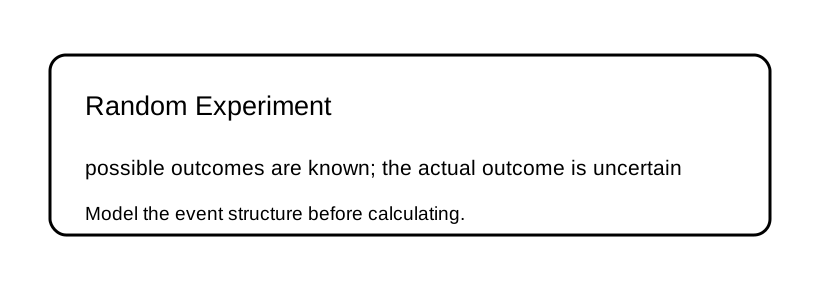
Random experiment
مش مجرد وصف — دي معاينة من المحتوى الفعلي.
داخل المسار
صور وفيديوهات وأمثلة مأخوذة من المحتوى المنشور نفسه، حتى تعرف أسلوب التعلم قبل التسجيل.
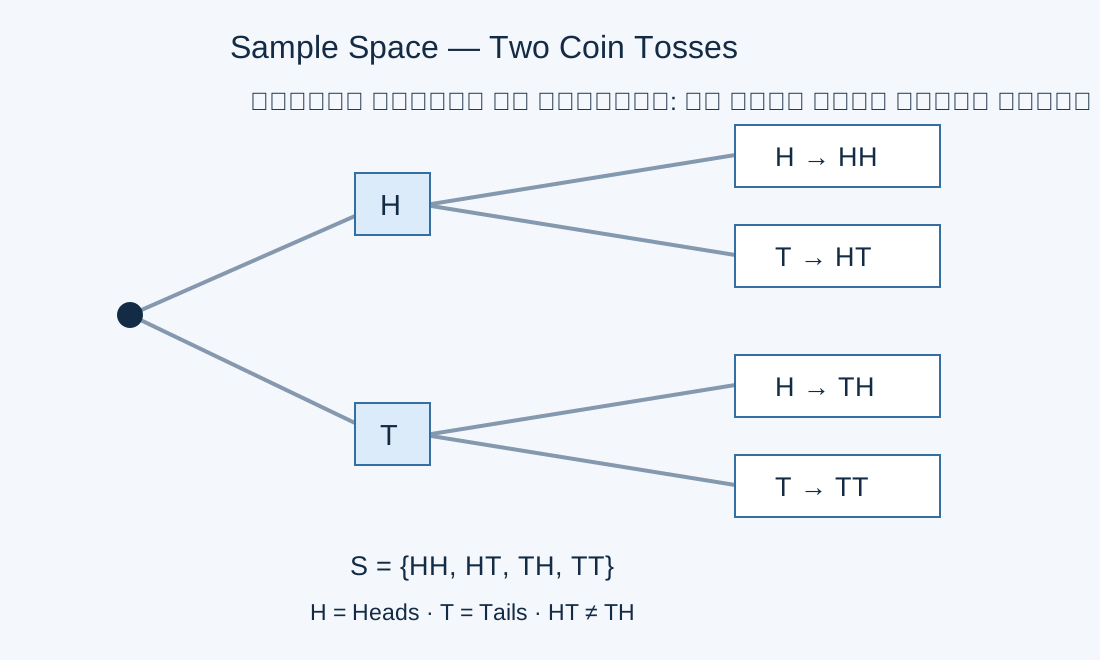
Sample space
Probability Foundations — Build the Model Before the Formula
Sample space
Probability Foundations — Build the Model Before the Formula
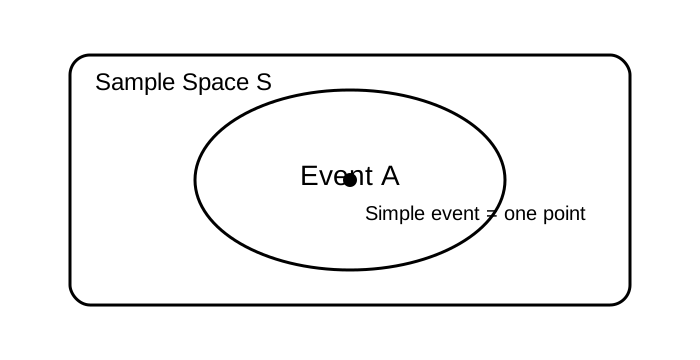
Events and simple events
Probability Foundations — Build the Model Before the Formula
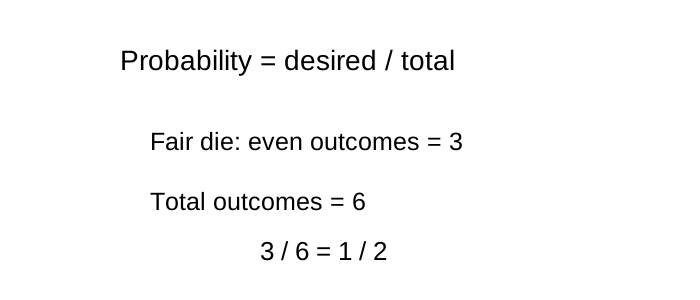
Equally likely probability rule
Probability Foundations — Build the Model Before the Formula
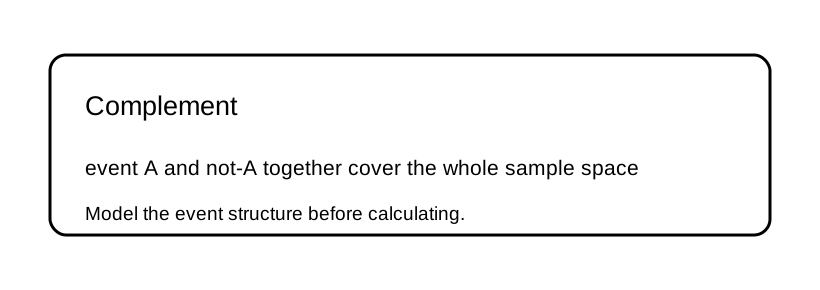
Complement of an event
Probability Foundations — Build the Model Before the Formula
Random experiment
Sample space
All possible outcomes are known, but before the experiment we do not know which one will occur.
Separate the experiment from possible outcomes and the observed result.
The sample space is the set of all possible outcomes; missing an outcome makes later probability calculations wrong.
S={HH,HT,TH,TT}; four sample points.
An event is any subset of the sample space. A simple event contains one sample point.
When sample points are equally likely, probability equals desired outcomes divided by total outcomes.
خطة التعلم
ابني Sample Space وEvents والقواعد الأساسية.
Random experiment
Recognize a random experiment and distinguish outcomes that are known from the outcome that actually occurs.
Sample space
Construct the complete sample space S for coin and die experiments.
Events and simple events
Interpret an event as a subset of S and identify simple events.
Equally likely probability rule
Compute probability as desired outcomes divided by total equally likely outcomes.
Complement of an event
Use P(A') = 1 - P(A) and interpret impossible/certain events.
Union and intersection
Translate 'A or B' and 'A and B' and apply the addition rule.
فرّق بين Disjoint وIndependent وحل مسائل النرد واللغة الاحتمالية.
Disjoint events
Recognize mutually exclusive events and use their simplified union rule.
Independent events
Test independence using P(A∩B)=P(A)P(B).
Disjoint versus independent
Avoid confusing mutually exclusive events with independent events.
Two-dice sample spaces
Model distinguishable dice with 36 ordered outcomes.
At least, neither, but not
Translate probability wording into event operations before calculating.
Multi-step probability strategy
Move from givens to events, rule selection, substitution, and checking.
افهم given information وإعادة بناء sample space.
Conditional probability meaning
Interpret P(A|B) as probability after restricting attention to cases where B occurred.
Conditional probability formula
Apply the conditional probability definition using intersection and the conditioning event.
Independence through conditional probability
Connect independence with unchanged conditional probability.
Conditional sample spaces
Rebuild the relevant sample space after information is given.
Dice conditional probability
Solve conditional probability using ordered dice outcomes.
Urns without replacement
Track changing probabilities in sequential selections without replacement.
من partition وtotal probability إلى posterior reasoning.
Partition of a sample space
Recognize mutually exclusive and exhaustive events forming a partition.
Total probability
Compute an event probability across partition branches.
Bayes theorem
Reverse a conditional probability using prior probabilities and likelihoods.
Probability trees
Organize prior and conditional probabilities in a branching tree.
False positives and posterior probability
Apply Bayes reasoning to diagnostic-test style problems.
Machine-source inference
Infer the likely source of an observed defective product using Bayes theorem.
من outcomes إلى PMF/CDF/Expected Value/Variance.
Random variable
Map random experiment outcomes to numerical values.
Discrete random variable
Recognize countable random-variable values.
Probability mass function
Build and validate a discrete probability distribution.
Cumulative distribution function
Compute cumulative probabilities for a discrete random variable.
Expected value
Calculate and interpret the mathematical expectation.
Variance and standard deviation
Measure spread using variance and standard deviation.
Model check ثم exactly/at least/at most والتطبيقات.
Bernoulli process
Check repeated independent success/failure trial assumptions.
Binomial random variable
Identify number of successes in n trials.
Binomial probability formula
Use n, p, q and x correctly in the binomial formula.
Exactly x successes
Translate exactly into one binomial probability.
At least x successes
Translate at least into a tail sum or complement.
At most x successes
Translate at most into a cumulative binomial probability.
Rate وlambda وtime scaling وtails.
Poisson process intuition
Recognize random event counts occurring at a rate over an interval.
Poisson parameter
Interpret the Poisson mean/rate parameter.
Poisson probability formula
Calculate the probability of exactly x events.
Exactly x Poisson events
Compute a single Poisson probability.
At most x Poisson events
Sum Poisson probabilities through x.
Upper-tail Poisson events
Use sums or complements for upper-tail probabilities.
PDF/CDF/area/expectation/variance.
Continuous random variable
Distinguish continuous from discrete random variables.
Probability density function
Check nonnegativity and total area one for a PDF.
Point probability is zero
Understand why a single exact value has zero probability for a continuous variable.
Probability as area
Interpret interval probability as area under the density curve.
Continuous CDF
Build F(x) by integrating the density.
Interval probabilities from PDF or CDF
Compute probabilities over bounded and tail intervals.
Bell curve وZ-score وtable وregions والتطبيقات.
Normal distribution
Recognize the bell-shaped normal model and its parameters.
Standard normal variable
Recognize the standard normal distribution.
Z-score transformation
Standardize X using its mean and standard deviation.
Normal-table meaning
Interpret the cumulative probability reported by the standard normal table.
Positive Z lookup
Locate a positive Z value in the table.
Negative Z by symmetry
Use symmetry to handle negative Z values.
Joint/Marginal/Independence/Expectation/Covariance.
Joint probability distribution
Represent simultaneous values of two discrete random variables.
Valid joint PMF
Check nonnegativity and total joint probability one.
Joint-event probability
Sum cells satisfying conditions on X and Y.
Marginal distribution of X
Sum joint probabilities over Y.
Marginal distribution of Y
Sum joint probabilities over X.
Independence of random variables
Check whether joint probabilities factor into marginals.
Population/Sample، grouped/ungrouped، central tendency، dispersion وCV.
Population and sample
Distinguish a statistical population from a selected sample.
Parameter and statistic
Distinguish population characteristics from sample characteristics.
Ungrouped data
Recognize data in its original ungrouped form.
Frequency
Count how often a data value occurs.
Frequency table
Arrange observed values with their frequencies.
Reading a frequency distribution
Recover counts and totals from a frequency table.
Pearson r ثم least-squares regression والتنبؤ.
Correlation concept
Describe correlation as strength and direction of association between two variables.
Positive and negative correlation
Recognize increasing-together and opposite-direction patterns.
Strength from scatterplots
Distinguish strong, weak, and no linear correlation visually.
Correlation is not regression
Distinguish measuring association from fitting a prediction line.
Pearson correlation coefficient
Calculate Pearson's correlation coefficient from paired observations.
Correlation range and sign
Interpret the coefficient's sign and allowable range.
Statistics & Probability (BS1103)
افهم الاحتمالات والإحصاء خطوة بخطوة بالعربي مع الحفاظ على English terminology، من Random Experiment حتى Regression.